Here’s the thing about my weeknight dinner rotation: it got tired. We were stuck in the same loop of rice bowls and quick stir-fries, and honestly, the monotony was starting to show in my lack of enthusiasm for dinner. Look, I love a good grain bowl as much as the next person, but I needed something that required a little more hands-on action. That’s when I started making spicy tuna kimbap rolls, and let me just say, the changeup has been a game changer for my lunch and dinner plans.
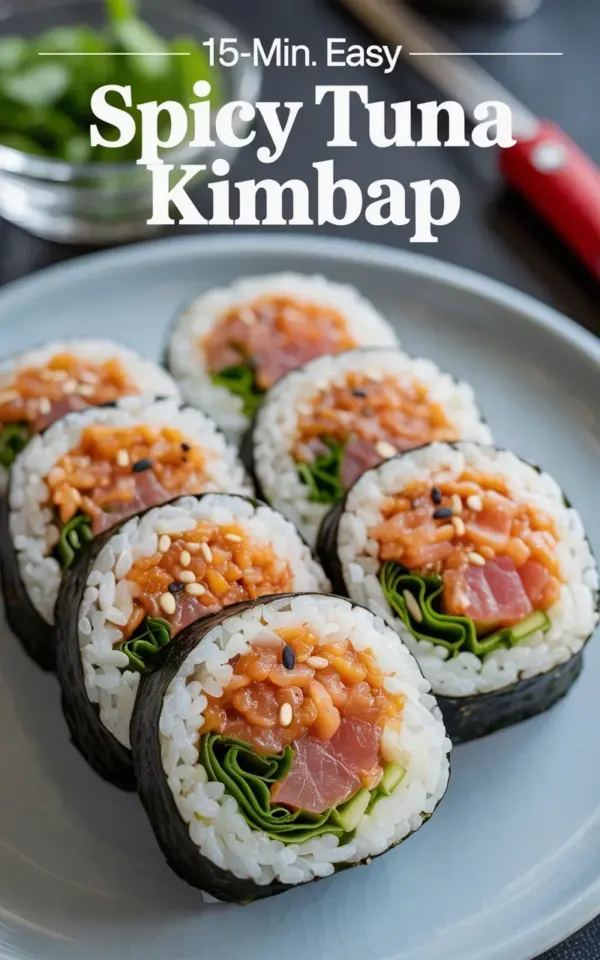
The photo above, with those thick slices lined up on the gray plate, is exactly what you are getting. That vibrant orange-pink tuna mix, the bright green seaweed wrapping it all up, and those little black sesame seeds scattered on top, that is the visual siren song that got me into the kitchen. This is a quick, satisfying, and honestly impressive meal that anyone can pull off on a busy evening. You don’t need a bamboo mat that costs a fortune or a chef’s knife that costs a paycheck, you just need a little patience and a good appetite.
## Why Spicy Tuna Kimbap Works for Busy Weeknights
After a long day (or even a long morning), the last thing I want is a complicated recipe with a million dirty dishes. What I crave is a meal that comes together with minimal fuss but still tastes like something I actually meant to cook. Spicy tuna kimbap fits that bill perfectly because the filling is raw, so there is zero cooking time for the fish. No grilling, no baking, just a quick chop and a stir.
This is also a seasonal, trend-aware kind of meal. It’s light enough for those late August days when it’s still hot out, but substantial enough to hold its own when the evening gets a little cooler. You can pack it for a picnic, take it to work, or serve it as a fun, interactive dinner that feels a bit more special than a standard sandwich. It’rsquos the perfect lunch or dinner for when you want Korean food but do not feel like waiting for takeout to arrive.
## What Makes This Spicy Tuna Mix So Good
The heart of this roll is, unsurprisingly, the spicy tuna filling. It is not just about dumping canned tuna into a bowl and calling it a day. No, the magic comes from the sauce and the texture. You want to use a good quality tuna, preferably sashimi-grade. If you can’t find that, try sushi-grade or even a really fresh ahi tuna from your local fish counter. Just tell the person at the counter it’s for sushi, and they will help you out.
To make the sauce, you will need gochujang (Korean chili paste), a little bit of sesame oil, maybe a touch of soy sauce, and a tiny bit of sugar to balance out the heat. Mix that into your finely chopped tuna, and add some crunch. I like to add finely chopped cucumber and a little bit of kimchi for an extra kick. The result is a filling thatrsquos moist, but not soggy, and it has that perfect balance of spicy, savory, and a little bit sweet. Seriously, it’s good enough to eat with a spoon straight out of the bowl, but I hope you save some for the rolls.
## The Rice Matters More Than You Think
Ok so, let’s talk about the sushi rice. This is not the part to skip, and it’s where a lot of homemade kimbap goes sideways. You need short-grain or sushi rice that is sticky enough to hold together. If you use long-grain rice, your rolls will fall apart faster than a cheap umbrella in a storm. It just won’t cling to itself the way you need it to.
After the rice is cooked, season it with a mixture of rice vinegar, a pinch of salt, and a kiss of sugar. You have to do this while the rice is still warm. Then, and here is a crucial step, let it cool down to room temperature before you try to assemble anything. Spreading hot rice on a sheet of seaweed is a recipe for soggy, torn nori. So, let the rice hang out for a bit. While you’re waiting, you can prep the rest of your veggies.
Also, a quick note on the texture: the rice provides the cool, neutral canvas for that spicy tuna. It’s the anchor that makes every bite of vibrant orange-pink filling feel balanced. I usually season my rice a little more than I think I need to, because once it’s inside the roll, the flavor has to stand up to the strong gochujang in the tuna.
## My Best Kimbap Rolling Tips
Alright, this is where the real fun begins. Before you even pick up a sheet of nori, lay out all your ingredients within arm’s reach. This is a fast process once you start, and you don’t want to be fumbling for a bowl of sesame seeds while you have rice everywhere. Gimbap rolling is intimidating at first, but it’s actually more forgiving than you think. My first few rolls looked like lumpy footballs, but you better believe they still tasted great.
Here is my simple method:
– Place a sheet of nori on your bamboo mat (or a clean kitchen towel, which honestly works even better than a plastic mat). The shiny side should be facing down.
– Wet your hands with a little water to prevent the rice from sticking, then spread a thin, even layer of rice over about 2/3 of the seaweed.
– Lay your ingredients in a horizontal line about an inch from the edge closest to you. Don’t overstuff it. This is a common mistake. Less is more.
– Use the mat to lift the edge of the seaweed over the filling, and tuck it underneath the ingredients. Apply a little pressure to create a tight roll.
– Use a sharp knife to slice the roll into thick pieces. For clean cuts, wipe the knife blade with a damp cloth between each slice. A wet knife is your best friend here, trust me.
See? It’s not that bad. The thick slicing is what makes the rolls look so great in the photo, with all those pretty layers showing off their colors.
## How to Slice Kimbap Without Smashing It
This sounds like a small detail, but it really makes a difference between a roll that looks professional and one that looks like a mess. The number one mistake is using a dull knife. Its not gonna slice through the seaweed, it is going to squish the roll flat. You want a very sharp, non-serrated knife for this job. I have a super old, slightly bent knife that somehow works perfectly, but a sharp santoku knife is perfect for this.
My other big tip is to pat the knife dry and wet it again between each cut. This keeps the rice from sticking to the blade and dragging out the filling. When you slice, use a quick, sawing motion, don’t just press down hard. You are looking for a clean cut, not a crushing blow. It takes a little practice, but once you get into the rhythm of it, you can slice a whole roll in about fifteen seconds. The payoff is seeing that beautiful cross-section of white rice, bright green seaweed, and the pink tuna mixture in every single piece.
## Make This Lunch Your Own (and Store the Leftovers)
One of the best things about this easy recipe is how customizable it is. While the spicy tuna is the star, you can absolutely play with the supporting cast. For a classic crunch, add a strip of cucumber or pickled radish (danmuji). If you want a little extra flavor, a small piece of fried egg or a bit of imitation crab.
And for storage, here’s a real human opinion: kimbap is best when it’s fresh. Like same-day fresh. Honestly, it’s a relief. You don’t have to stress about meal prepping it for the week. Make it for a specific lunch or dinner, enjoy it immediately, and let the leftovers be a happy accident if they even last that long. I usually wrap any leftovers in plastic wrap or in an airtight container. They will hold in the fridge for a few hours, but the rice will harden a bit. So just keep that in mind.
That being said, I have a weird habit of saving a couple of slices to eat cold out of the fridge later that night. You know, standing in the kitchen, door open, eating straight from the container. It’s not glamorous, but it is my favorite part of the process.
So there you have it. A fast, fresh, and ridiculously flavorful meal that answers the “what’s for dinner” question with a little bit of flair. Try this spicy tuna kimbap on your next busy weeknight and let me know how your rolling technique goes. I’d love to hear in the comments if you have a favorite filling addition.
Leave a Comment