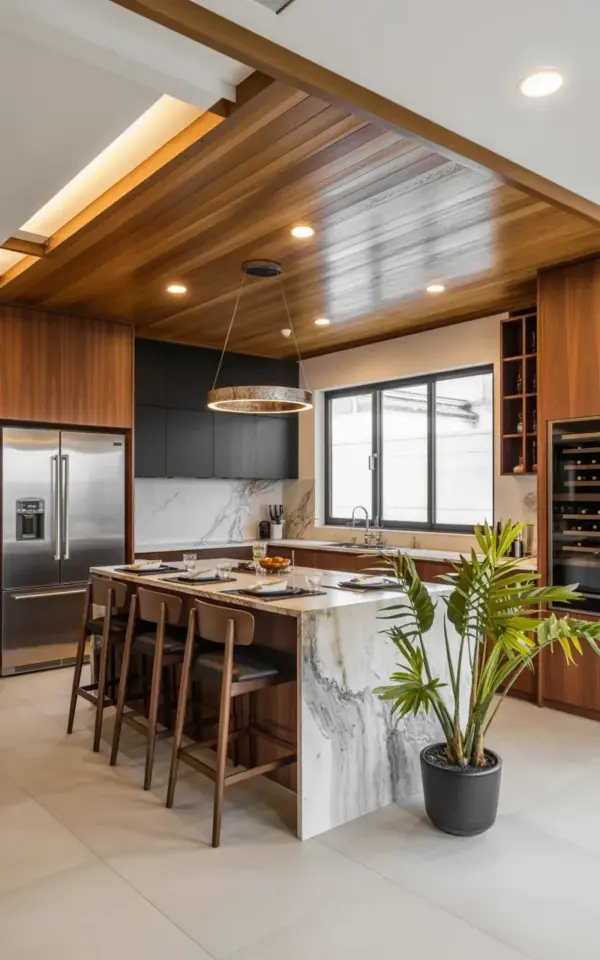
The marble island in this photo isn’t the star of the show. It just looks like it. Walk into this luxury kitchen and your eye lands on the white and gray veined stone, the waterfall edge, the way the light catches the polished surface. But the reason that marble island works so well has almost nothing to do with the stone itself. It’s the wood ceiling above it, the black window frames across the room, and the gray veined backsplash that make it feel intentional. Without those connections, that same island would look like a showroom slab dropped into the wrong house.
The Big Mistake: Treating Marble and Wood as Separate Decisions
Most kitchen design projects go wrong when the marble island is chosen in isolation. People fall in love with a slab, then pick wood cabinets separately. The result is a room that feels like two different kitchens fighting each other.
Here, the wood paneling on the ceiling and walls is warm and pronounced. That kind of warmth needs a counterpart. It can’t just be ignored. The mistake is thinking you can simply balance warm wood with a neutral stone. Neutral doesn’t connect, it just coexists. And coexisting is what makes a room feel accidental.
How to Pair a Marble Island with a Wood Ceiling Without Clashing
Look at the backsplash in this image. It’s white marble with gray veining, closely related to the marble island. That’s the connection. The island’s gray veins are echoed in the backsplash, which means the wood ceiling and the island are no longer separate. They’re linked through the same stone family.
So when you’re selecting a marble island for a kitchen with warm wood paneling, look at the veining as a tool. Don’t choose a slab just for its base color. Choose it because the gray, taupe, or even gold veins match something else in the room. It could be the backsplash, the window frames, or even the hardware on the cabinets. Even a subtle thread of color will do.
Why the Grey Veined Marble Backsplash Is Your Best Friend
Honestly, the backsplash is doing more work than people realize. It sits there quietly behind the island, but it’s the single strongest connection to the countertop. When you have a large marble island with dramatic veining, the backsplash should speak the same visual language.
I’ve seen homeowners choose a plain white subway tile to save money, then wonder why the island looks disconnected. The gray veined marble backsplash here creates a continuous line of pattern across the kitchen. It gives the eye a story to follow. Your backsplash doesn’t have to be identical to the island, but it should share the same tone and at least one vein color.
Black Window Frames and Black Cabinets: The Contrast Trick
Here’s the thing: black window frames are a bold choice. They could easily feel heavy against warm wood. But they work because the upper cabinets in this kitchen are also black. That repetition gives the eye a path.
The black frames and black cabinets create a dark line that anchors the room. So the wood ceiling feels like a warm canopy instead of a cave. I’ve watched people skip this part and then wonder why their wood ceiling feels overbearing. It’s not the wood. It’s the lack of a dark contrasting element to dial the warmth down. The black framing is doing more work than the marble in this photo, not gonna lie.
The Waterfall Marble Island: Do It or Don’t Do It
The waterfall edge on this marble island isn’t a decoration. It’s a structural statement that makes the island feel like a solid block of stone. When you pair that with a wood ceiling, you get a beautiful contrast between heavy and light.
But here’s a common mistake: people request a waterfall edge and then stop the marble an inch above the floor. That completely ruins the effect. It should go all the way to the flooring, or at least feel like it does. In this kitchen, the waterfall edge completes the island’s connection to the ground while the wood panels pull the eye up. That push-pull is exactly what makes the space feel balanced.
Bar Stool Pairing for a Marble Island: What Actually Works
Now look at the seating. Four dark brown wooden bar stools with black cushions, lined up along the island. That’s not an accident. The dark brown wood in the stools relates to the wood ceiling. The black cushions relate to the black window frames and cabinets. So even the seating is acting as a visual glue.
If those stools were light oak or white leather, the whole connection would weaken. I know that sounds dramatic, but I’ve walked into kitchens where the wrong stools made an expensive island look like a diner counter. When you have a bold marble island, your bar stools are a chance to reinforce the palette, not introduce a third wood tone or a conflicting color.
A Simple Checklist for Your Own Luxury Kitchen Wood Paneling
You don’t need a wood ceiling to make this mistake. Any textured surface next to a marble island needs the same treatment. Start by identifying the dominant visual elements in your kitchen, then find one detail in the marble that connects to each. For example, if your cabinets are matte black, choose a marble with dark gray veins that read almost black from a distance. If your backsplash is a solid tile, repeat that tile’s undertone somewhere in the island’s veining. And don’t forget the small stuff.
– Match the undertone of
Leave a Comment